.svg)
Deterministic Edge Control for
Real-Time Clinical Infrastructure
Systems that respond instantly and predictably to clinician intent — without cloud latency or guesswork.
Invited by National Science Foundation to submit a Phase I SBIR proposal for a deterministic edge control platform for real-time clinical infrastructure
ViVE/HLTH 2026 Startup HiVE Pavilion — A Top National Showcase for Healthcare Technology Innovation
Selected Top Ranked Critical Technology "Spotlight" and for Oral Presentation at TechConnect World 2026 — Including a Live Presentation to Federal & Industry Leaders
Dr. Venkat Shastri, Chair of Electrical & Computer Engineering at the University of San Diego, Joins Intelligent Clinical Systems’ Board of Directors
Our ambient intelligent modular rack guidance system turns ordinary storage racks into context-aware, voice-activated guided networks. By combining hands-free interaction with dynamic lighting, it directs users to the right item in seconds — cutting search time, reducing stress, and improving operational flow in critical environments.


Nurses waste critical minutes searching for the supplies they need – disrupting workflow, increasing stress, and compromising patient safety.
Yet hospital supply rooms remain technology deserts – unintelligent, unconnected spaces
Our edge-based AI turns ordinary storage racks into intelligent runway lights—guiding nurses to the right supplies in seconds. More than inference, our technology provides real-time, embodied guidance.
The only intelligent guidance system of its kind—built to transform how nurses navigate critical environments.
Turning Storage Into Actionable Intelligence
Our ambient intelligent modular rack guidance system turns ordinary storage racks into context-aware, voice-activated guided networks. The network transforms static storage into an intelligent, responsive environment that works seamlessly with clinical workflows, while hierarchical learning across racks continuously improves accuracy and performance over time. This powerful combination of edge-based AI and systemwide rack synchronization creates a self-improving guidance infrastructure that gets smarter with every interaction.
.avif)
Welcome to the Era of Ambient Intelligent Infrastructure™
Where intelligent systems live at the edge, listen to intent, and illuminate human action in real time.
10-Second Retrieval
Find supplies faster than ever


Edge Native
Runs entirely at the edge — no cloud required.

Autonomous Network Intelligence
Distributed mesh of intelligent racks continuously learns, adapts, and heals itself

Low-Cost Retrofit
Works with existing infrastructure
Privacy-Preserving
Your data stays secure

How It Works
AI Powered Voice-to-Visual Pipeline
Voice Command
A nurse speaks a request for an item which activates the system through a low-power edge listening pipeline.

On-Device Processing
An edge-native microprocessor runs all AI computation directly on-device, eliminating cloud dependence to ensure near instantaneous response and uncompromising data privacy.

Visual Guidance
Intelligent LED illumination on the racks, direct nurses, unambiguously, and precisely to the correct location.


Our system is built on the principles of secure by design.
This retrofit-friendly architecture integrates seamlessly with existing storage systems — no expensive replacement or proprietary lock-in.
This is not incremental but a new capability: adaptive, auditable, and privacy-preserving guidance,running natively at the extreme edge.
Validated Metrics
Current prototypes demonstrate:
Median retrieval time
Reliable and fast supply retrieval
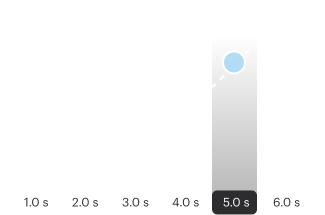
Item accuracy
in 65–75 dB noise environments

On-device inference latency
Ultra-fast information processing

Technology Readiness Level (TRL)
prototype validated in simulated clinical and logistics environments


These metrics show the system's potential to deliver measurable workflow improvements in real-world settings.
Application Areas

Healthcare
Faster retrieval, less burnout, better care — advancing the Quadruple Aim.

Logistics & Warehousing
Faster, smarter warehouse operations with fewer errors.

Laboratories
Precise, time-sensitive retrieval in regulated environments
Commercial Differentiation
Key differentiators:
Edge-Native Architecture
No cloud dependency means lower latency, improved privacy, and reliable performance in noisy, high-stakes environments.
Retrofit Integration
Installs onto existing racks, avoiding costly capital replacement and enabling rapid deployment across diverse facilities.
Workflow Adaptivity
Learns from usage patterns to continuously improve guidance accuracy without manual reconfiguration.
Regulatory & Privacy Alignment
Designed to comply with HIPAA and hospital security standards by keeping data local.
Cross-Sector Scalability
Applicable not only to healthcare but also to logistics, laboratories, and other high-throughput environments.
This combination of technical defensibility, deployment speed, and operational impact positions Intelligent Clinical Systems™ to lead the emerging category of edge native intelligent guidance infrastructure.
Our Edge
We combine adaptive intelligence, secure edge computing, and retrofit simplicity to create infrastructure that learns, evolves, and scales with you
Roadmap: Advancing edge inference accuracy, BLE mesh synchronization, and ergonomic workload validation toward integrated clinical prototype testing and TRL 4 readiness (Q1 2026).

Intellectual Property
Patent Pending. Our system architecture, core logic, and algorithms are protected; only high-level system functionality and performance data are shared publicly.
Due to ongoing patent filings and research partnerships, select system visuals are withheld while the technology completes formal IP protection and validation.
Our current R&D efforts focus on validating the system’s speed, accuracy, and reliability under real clinical conditions.

Recognition & Support
- UACI Incubator: Part of the University of Arizona Center for Innovation
- Capstone Sponsor: A team of six University of Arizona senior engineering students is actively engaged in the design and development of the system architecture.
- NSF SBIR Project Pitch Invited for Phase 1 proposal
- IdeaFunding Tuscon: Invited to pitch at IdeaFunding competition

Adaptive Edge Intelligence
The Core Innovation
Intelligent Clinical Systems™ is establishing the foundational capability for adaptive, privacy-preserving, real-time guidance systems deployed at the extreme edge.
Our system is engineered on embedded microcontrollers and optimized through deterministic toolchains that ensure precise, real-time execution. Every layer—from voice processing to LED guidance—is compiled and profiled through edge-native frameworks such as Zephyr, ESP-IDF, and TensorFlow Lite Micro, guaranteeing predictable performance under demanding clinical conditions.
Beyond a Product—Platform Architecture
Intelligent Clinical Systems represents more than a product: it’s a platform architecture redefining how humans interact with environments. By transforming spoken intent into light-based guidance, ICS turns ordinary storage racks into responsive, intelligent collaborators that think, adapt, and illuminate in real time. Built on a validated, edge-native contextual inference framework, it delivers ambient intelligence without the overhead—bringing adaptive learning and federated improvement to existing infrastructure in a low cost retrofit. Reviewers describe it as technology that feels alive—not because it replaces people, but because it responds to them.

Robert Schmid
Founder
%201.avif)
Robert Schmid
Founder & CEO, Intelligent Clinical Systems
Robert Schmid is a critical care nurse and cybersecurity engineer.
With over 15 years of acute care experience and advanced certifications in cybersecurity, networking, and cloud architecture, including CompTIA Security+, CompTIA Network+, and AWS Certified Cloud Practitioner, Robert bridges frontline healthcare and emerging technology. He holds a Master of Science in Nursing (MSN), Clinical Nurse Specialist (CNS) credential, and Master of Engineering in Cybersecurity, uniting the disciplines of clinical science and secure systems design.
Drawing on firsthand experience, including five months on the frontlines in New York City during the earliest and most critical phase of the COVID-19 pandemic, Robert has witnessed how system inefficiencies and information overload impact care when every second matters.
His work integrates clinical insight with edge-native AI design to create intelligent, privacy-preserving systems that enhance human performance in high-stakes environments. By combining deterministic engineering, cybersecurity principles, and real-world clinical workflow knowledge, he leads the development of adaptive infrastructure that learns locally, responds instantly, and protects patient data by design.
In addition to his clinical and engineering roles, Robert serves as a professor of nursing, mentoring the next generation of clinicians in critical thinking, patient safety, and evidence-based practice. His dual perspective, as both educator and ICU nurse, fuels his vision to merge the science of care with the precision of engineering.
Under his direction, ICS is redefining how healthcare systems think, respond, and guide, turning static storage into intelligent, adaptive infrastructure that gives nurses back their most precious resource: time—the time to care for themselves and the patients who depend on them.
Education
- M.S. in Nursing, University of San Diego, 2010
- Clinical Nurse Specialist – Critical Care, University of California, San Francisco, 2014
- M.Eng. in Cybersecurity, University of San Diego, 2020
Certifications
- CompTIA Security+
- CompTIA Network+
- AWS Certified Cloud Practitioner

Meet the team
Tony Grega
CFO

Tony Grega
CFO, Intelligent Clinical Systems
Tony Grega (Anthony Grega) is a finance and operations executive with deep experience supporting both established organizations and early-stage ventures across healthcare/biotech, manufacturing, software, and technology-enabled services. He has held CPA (Ontario) and CMA credentials and brings hands-on expertise spanning FP&A, process improvement, supply chain, cash management, and margin expansion.
Tony currently serves as a Subject Matter Expert in Accounting & Finance with the University of Arizona Center for Innovation, advising emerging companies on financial readiness and execution. He has supported capital formation through convertible debt, equity, and other financing instruments, and has worked in complex operational and compliance environments, including government/DCAA accounting and SBIR grant management.
He has also contributed to successful exits, including the sale of Instant Bioscan to Mettler-Toledo and CyberPatrol to ContentWatch.
Susan Garber
Advisor – Marketing & Branding
%201%20(3).avif)
Susan Garner
Advisor: Subject Matter Expert, Branding, Marketing & Communications Strategies
Susan Garber works to lay the strategic foundation for internal and external branding, marketing and communications, which aids in securing grants and other funding opportunities.
She comes to Intelligent Clinical Systems with years of experience helping companies large and small identify and execute their marketing strategy.

Hung Cao
Senior Technical Advisor
%201%20(4).avif)
Hung Cao
Senior Technical Advisor
Hung Cao received his B.Sc. degree in electronics and telecommunications from Hanoi University of Science and Technology, Vietnam in 2003. He then served as a lecturer at Vietnam Maritime University from 2003 to 2005. He earned an M.Sc. and Ph.D. in electrical engineering from the University of Texas at Arlington in 2007 and 2012, respectively. After his Ph.D. study on biosensors and bioelectronics, Cao received training in bioengineering and medicine at University of Southern California (2012-2013) and University of California, Los Angeles (2013-2014). In 2014-2015, he worked for ETS, Montreal, QC, Canada as a research faculty. In fall 2015, Cao became an assistant professor of electrical/biomedical engineering at University of Washington (UW). Cao joined the UC Irvine Department of Electrical Engineering and Computer Science in September 2018. His HERO lab focuses on the applications of micro- bio-sensors and bioelectronics for health monitoring in humans as well as biological studies in animal models. Cao is one of the pioneers in utilizing flexible microelectronics to study heart disease in zebrafish. He is a recipient of the UW’s RRF Award (2016), the NSF CAREER Award (2017) and one of the only two nominees under UW competing for the prestigious Moore’s Inventor Fellowship (2017).
Education
Ph.D., Electrical Engineering, University of Texas at Arlington, 2012.
M.Sc., Electrical Engineering, University of Texas at Arlington, 2007.
B.Sc., Electronics and Telecoms, Hanoi University of Science and Technology, 2003
%202.avif)
Steven Wood
Advisor
%201%20(2).avif)
Steven Wood
Senior Strategic Advisor
Steven Wood brings 25 years of startup and executive management experience to the team. Steven has helped two startups grow and have successful exits. He’s been a mentor for numerous teams in the NSF I-Corps site and TEAMS programs supporting their customer discovery process.
Wood received his electrical engineering degree from Northeastern University in Boston. Through his co-op period with The Massachusetts Institute of Technology, he worked as a systems engineer for RCA Aerospace Systems in Burlington, Massachusetts; Somerville, New Jersey; and Mountaintop, Pennsylvania. He received undergraduate and graduate degrees in business administration.

Founders Vision
Intelligence at the Edge
I set out to redefine real-time intelligence bringing speed, privacy, and reliability directly to the edge, where care is delivered and seconds count.
Most systems try to solve real-time guidance through cloud infrastructure or Wi-Fi–dependent networks.
But in mission-critical environments, where milliseconds matter and privacy cannot be compromised the cloud becomes a liability. Latency, connectivity loss, and data exposure are unacceptable when human performance and patient safety are on the line.
I chose a different path: to move intelligence entirely to the edge.
Every aspect of our architecture, from voice understanding to visual guidance, runs on embedded hardware with deterministic timing and zero reliance on external connectivity. Our ambient intelligent guidance engine powers a voice-to-visual pathway that transforms spoken intent into precise, real-time illumination—directing clinicians instantly to what they need, without delay and without data ever leaving the room.
This is more than a product; it represents a new architectural model for ambient intelligence. It transforms static infrastructure into an adaptive, self-reliant, self-healing network that learns locally, syncs via BLE mesh, aggregates hierarchically, protects privacy by design, and delivers precision at human speed.
Built for the edge. Designed for trust. Engineered for the future of intelligent infrastructure.

Robert Schmid
Founder
MSN
CNS
RN
CompTIA Security+
CompTIA Network+
AWS Certified Cloud Practitioner
Federated Learning at the Edge
The system starts strong and continuously refines accuracy and responsiveness as usage grows.
Unit level (rack): Rapid local adaptation to accents, phrasing, and noise → higher recognition accuracy and faster disambiguation.
System level (room/zone): BLE mesh exchanges compressed model updates → shared vocabulary and fewer edge-case errors.
Facility level (fleet): Aggregated, anonymized insights refine priors → new deployments start smarter and cold-start time drops.

About Intelligent Clinical Systems™
Intelligent Clinical Systems (ICS) builds deterministic, edge-native clinical guidance technologies for high-acuity environments.
The company specializes in embedded sensing, ultra-low-latency inference designed to operate reliably within real-time clinical workflows.
Intelligent Clinical Systems™ has filed multiple provisional patent applications with the U.S. Patent and Trademark Office to protect its core innovations in AI-guided clinical supply retrieval.

Get in Touch
Ready to modernize your supply workflows? Let's start the conversation.


FAQs
1. Who are we?
We are a healthcare technology company building edge-native, real-time infrastructure that helps clinicians interact with physical environments more efficiently and reliably. Our focus is reducing workflow friction in high-acuity clinical settings.
2. What problem are we solving?
In hospitals, clinicians lose critical time searching for supplies, navigating fragmented systems, and compensating for broken workflows. These inefficiencies increase cognitive load, delay care, and contribute to operational strain—especially in time-sensitive environments like ICUs and EDs.
3. What does our technology do?
Our technology enables spoken intent to trigger immediate, spatially precise guidance within clinical environments. The system operates locally, responds in real time, and integrates directly into physical infrastructure such as supply rooms and storage areas.
4. Is this an AI product?
Yes—but it is AI embedded into infrastructure, not cloud-based analytics or retrospective decision support. The system uses on-device intelligence to respond instantly and predictably, without relying on external servers.
5. Does our system make clinical decisions?
No.
The system does not diagnose, treat, or recommend clinical actions. Clinicians remain fully in control at all times. The technology supports workflow and navigation, not medical decision-making.
6. Why is on-device (edge) operation important?
Edge operation ensures:
- Deterministic, low-latency response
- No dependence on network connectivity
- Strong privacy protections
- Reliable performance in high-noise, high-stress environments
This is critical in clinical settings where delays or outages are unacceptable.
7. Does our system collect or store patient data?
No.
The system does not collect PHI, patient identifiers, or audio recordings. Operational metrics are limited to system performance and aggregate usage patterns.
8. How is this different from typical healthcare IT or AI tools?
Most healthcare AI tools are:
- Cloud-dependent
- Retrospective (analytics, dashboards)
- Best-effort in latency and reliability
Our approach focuses on:
- Real-time response
- Deterministic behavior
- Physical-world interaction
- Infrastructure-level reliability
9. Who typically uses or sponsors our technology?
Common stakeholders include:
- Nursing leadership (ICU, ED, procedural areas)
- Clinical innovation and transformation teams
- Supply chain and operations leadership
- Clinical engineering / biomedical engineering
- IT teams (for governance and awareness)
10. Are we currently deployed in hospitals?
We are in pilot and validation stages, working with early partners to evaluate real-world performance, usability, and workflow impact in live clinical environments.
11. How are we validating the technology?
Validation includes:
- Real-world pilot deployments
- Measured workflow observations
- System performance benchmarking
- Independent technical evaluation
This work aligns with a Phase I SBIR invitation from the National Science Foundation, which serves as an external technical and commercialization validation gate.
12. Is our technology regulated?
The current system is designed as operational infrastructure, not a clinical decision-support or diagnostic device. Regulatory pathways will be evaluated as functionality expands, with safety and compliance treated as first-order design constraints.
13. What environments are we focused on first?
Initial focus areas include:
- ICU and ED supply rooms
- Procedural and perioperative storage areas
- Point-of-use clinical supply locations
These environments benefit most from reduced search time and lower cognitive load.
14. What is our long-term vision?
Our long-term vision is to create a reliable, real-time control layer for physical environments—starting in healthcare and extending to other safety- and mission-critical domains where humans must interact with complex infrastructure under pressure.
15. How can organizations engage with us?
Organizations can engage through:
- Pilot programs
- Innovation partnerships
- Technical evaluation collaborations
- Early adopter discussions
There is no obligation beyond the pilot phase.
Product

© 2025 Intelligent Clinical Systems™ LLC. All rights reserved.
Ambient Intelligent Infrastructure™, Aii™, and Aii Era™ are trademarks of Intelligent Clinical Systems™ LLC.